If you have no heat tonight, call now. The line is answered 24/7 and the first thing to do is check for carbon monoxide or a gas smell. If either is present, leave the building and call from outside before anything else.
If the house is safe, a few quick checks sometimes restore heat, and we will walk you through them. If they do not, we offer same-day appointments when available, including nights and weekends.
No Heat Tonight? Check These First
Work through these in order. Stop and call as soon as one of them points to a problem you should not touch.
- Leave if you smell gas or a detector sounds.Carbon monoxide or a gas smell means leave the building and call from outside. Do this before any other step.
- Check the thermostat.Make sure it is set to heat and above the room temperature. Replace dead batteries.
- Check power to the boiler.Boilers need electricity even when they burn gas. Look at the switch near the unit and the breaker. Reset a tripped breaker once only.
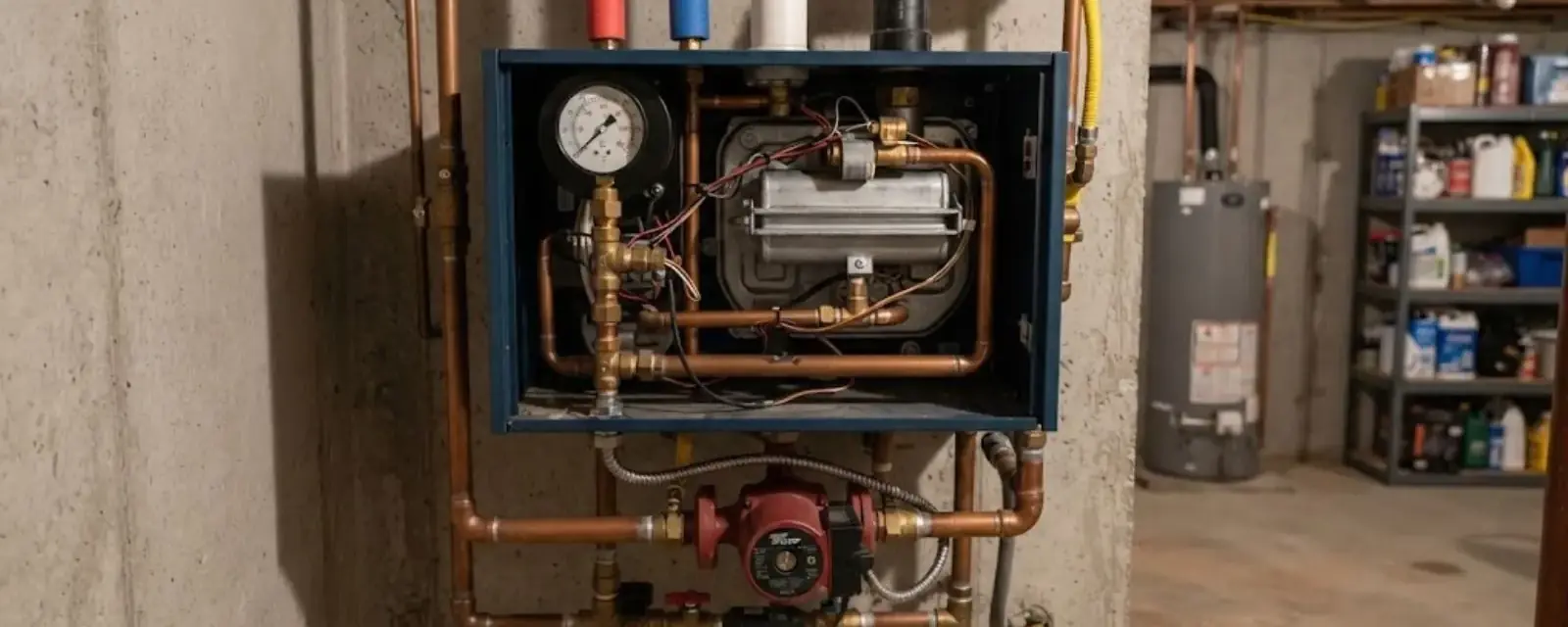
- Read the pressure gauge.Most home boilers sit in a modest range printed on the gauge or the label. A reading near zero means the boiler lost water, which usually means a leak. Do not keep adding water without finding it.
- Note any lights, codes or sounds.Write down what the display or lights show and whether the igniter clicks, glows or stays silent. Do not relight a gas appliance yourself. Tell us what you saw.
If radiators are cold at the top but warm at the bottom, trapped air may be the cause. A plumber can bleed it safely, and we explain the risks below.
Carbon Monoxide Means Leave and Call 911
Minnesota Energy Resources tells customers who suspect carbon monoxide to leave the building and call 911. For a gas odor or damaged gas line, its guidance is to leave the area immediately and call from a safe location. The company's leak line is 800-889-4970.
Rosemount residential areas are served by two gas utilities, Minnesota Energy Resources and Xcel Energy, according to the city. Which one serves you depends on your address. If you are not sure, leave and call 911 from outside, and tell the dispatcher you do not know which utility serves you.
Boiler Noises and Warning Signs
Boilers talk before they fail. These are the signs we see most.
Banging or knocking.
Often air trapped in the system or a pump issue. Can also come from scale in the heat exchanger.
Kettling or rumbling.
A sound like a kettle boiling means scale or sludge is overheating the water locally. It shortens the life of the heat exchanger.
Water at the relief valve.
A relief valve that leaks or discharges can mean pressure is climbing too high. Do not cap or plug it.
Pressure keeps dropping.
A boiler that needs frequent refilling has a leak somewhere, in a joint, a radiator valve or the boiler itself.
Cold radiators.
Cold spots usually mean air, a stuck valve or a failing circulator pump.
Frequent resets.
If the boiler locks out repeatedly, there is a cause behind it, such as a flame sensor, ignition or flow problem.
Boiler cold and the house cooling?
Call now. We answer 24/7 and schedule same-day boiler visits when available.
Boiler Symptoms and Who Should Handle Them
Some boiler tasks are safe for an owner. Others should stay with a plumber.
| Symptom | Likely cause | You can check | Plumber handles |
|---|---|---|---|
| No heat at all | Thermostat, power or lockout | Setting, batteries, breaker | Controls, ignition and circulator. |
| Low pressure | Leak or failed expansion tank | Gauge reading | Locating the leak and repairing it. |
| Cold radiators | Trapped air or stuck valve | Feel the top and bottom | Bleeding, valve and pump work. |
| Banging or kettling | Air, scale or sludge | Listen and note when | Flush, descale or repair. |
| Relief valve dripping | Overpressure or a worn valve | Look, do not touch | Test and replace the valve. |
| Pilot or igniter fails | Dirty sensor or worn igniter | Note the lights | Cleaning and parts, gas side with care. |
Never open a sealed boiler cabinet or work on a gas valve yourself.
If the boiler and the water heater share a failing flue or the hot water is off too, see our water heater repair page.
Why a Cold Night in Rosemount Is Serious
January average lows at the Twin Cities airport station run about 9 to 11 degrees Fahrenheit. That is the Minnesota Department of Natural Resources 1991 to 2020 normal and not a Rosemount reading. On a night like that a house with no heat cools quickly.
The practical tie-back is that a dead boiler is also a freeze risk for pipes along outside walls and in crawl spaces. If heat will be off for hours, open cabinet doors under sinks on exterior walls and let a thin stream of water run. Call us if a pipe has already frozen, and read about burst pipe repair.
Source: MN DNR Twin Cities Climate Calendar for January, 1991 to 2020 normals, airport station.
What Only a Plumber Should Open
A plumber works on the water side of a boiler: the pressure relief valve, the expansion tank, the fill valve, the circulator pump, air vents and leaks in the piping. Rosemount Express Plumbing is licensed and insured, and this is plumbing work and not heating and cooling work. Gas appliance work is done with proper care, and we tell you when a task needs the gas utility or another trade.
Owners can check the thermostat, the power switch and the gauge. Owners should not open the burner compartment, adjust a gas valve, remove the relief valve or cap a discharge pipe. Those tasks are a safety risk even when the boiler seems simple.
Repair or Replace an Aging Boiler
Age and repeat failures decide this more than any single part.
Repair makes sense when.
- The fault is one part such as a pump, valve or sensor.
- The heat exchanger is sound and the unit is not leaking inside.
- Repairs have been rare.
Replacement makes sense when.
- The heat exchanger is cracked or leaking.
- You are paying for repeated repairs each winter.
- The boiler cannot keep up with the house.
We tell you honestly if a repair is not worth it, and we price the options before any work.
What Changes the Price of Boiler Repair
We give a clear price before work starts. These are the drivers.
Ask your homeowner policy provider whether a sudden pipe or boiler leak is covered. Gradual wear usually is not.
Boiler repair questions for Rosemount homes
Yes. The line is answered 24/7. First check for carbon monoxide or a gas smell, and leave if you find either. If the house is safe, check the thermostat and power, then call.
If it is dripping from the relief valve or a pipe, switch off the boiler at its switch and place a bucket. Do not plug the relief valve. Call us.
Many owners can, with the boiler off and cool and a rag in hand. Hot water can scald. If pressure drops afterward, call a plumber.
Usually a leak somewhere. Refilling hides the issue and adds fresh oxygen that speeds corrosion. We find the leak.
It is a rumbling noise from scale or sludge overheating water inside the heat exchanger. It needs service before it shortens the life of the boiler.
We handle ignition problems with proper care. Do not relight a gas appliance on your own if you smell gas or have a detector alarm.
The city says two utilities serve Rosemount's residential areas, Minnesota Energy Resources and Xcel Energy. Check your gas bill. If you smell gas, leave and call 911.