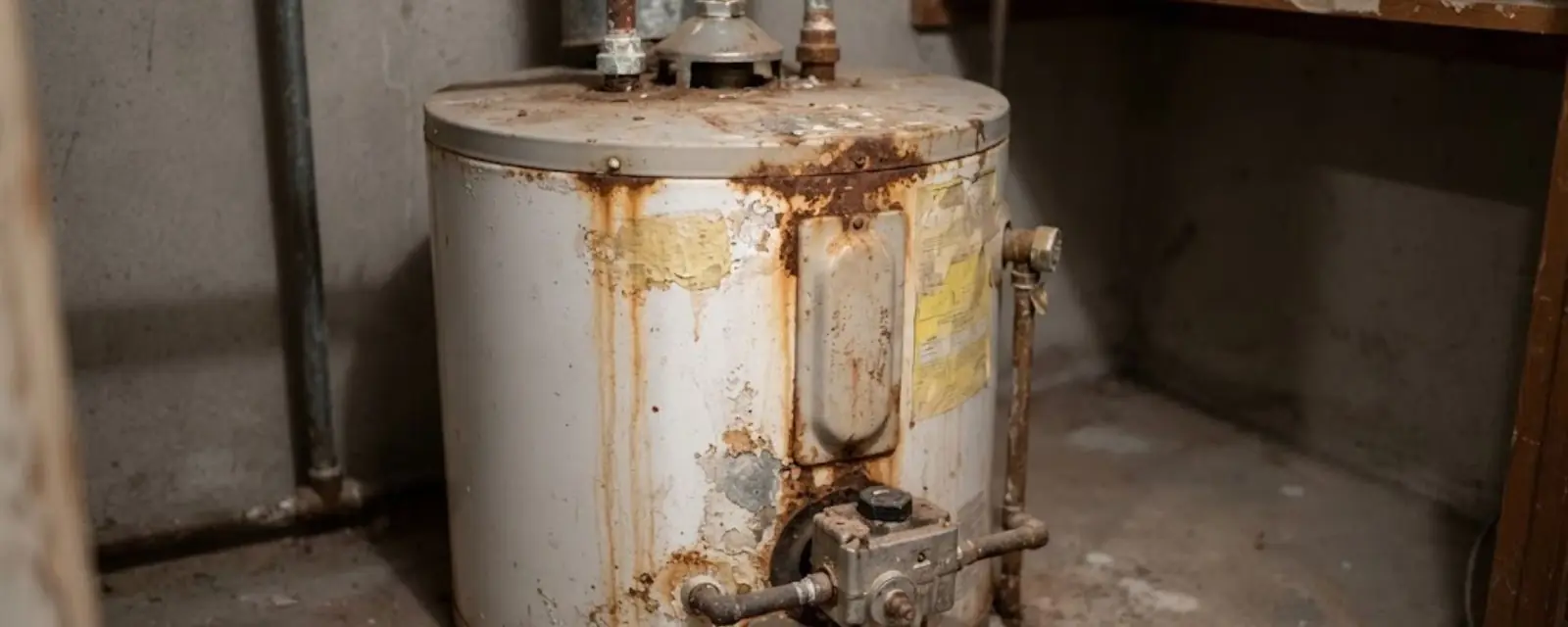
If water is spreading from your water heater in Rosemount, treat it as an emergency, and the line is answered 24/7. The first thing to do is stop the water feeding the tank and keep clear of the floor around it. Then call, and we will tell you what to do next while we set up a visit.
Most replacement calls are not a flood. They are a cold shower, a puddle that keeps coming back, or a tank that has started to knock. This page explains how to tell a tank that can be saved from one that cannot, what a same-day swap involves, and what moves the price.
Water on the floor right now? Do these first
A leaking tank can drop a lot of water in a short time, and the water inside is hot. Work through these in order and stop as soon as the water stops.
- Smell for gas before anything else.If the heater is gas-fired and you smell gas, do not touch switches or appliances. Leave the building and call from outside. Minnesota Energy Resources customers can use the leak line at 800-889-4970. Xcel Energy customers should call 911 once outside.
- Shut the cold supply to the tank.Find the valve on the cold pipe running into the top of the heater and turn it clockwise until it stops. If it will not move or you cannot find it, close the main shutoff where the water line enters the house.
- Cut power to an electric heater.Switch off the dedicated breaker for the heater. Never leave an electric element powered if the tank is draining, because a dry element burns out fast.
- Keep people and pets away from hot water.Water coming from the relief valve pipe or the tank seam can scald. Stay out of the puddle until the supply is closed and the tank has had time to cool.
- Move what you can and call us.Lift boxes, rugs and stored items off the floor. Then call the 24/7 line so we can plan a swap, often the same day when the schedule allows.
If you cannot stop the flow, the main shutoff or the city can help. The city says Rosemount Public Works can shut off service if a plumber advises it is necessary.
Replace it or repair it: how the decision usually falls
A heater that leaks from the tank itself is done. The steel shell has rusted through, and no part can fix that. Repair makes sense when a single part has failed on a tank that is otherwise sound, such as a thermostat, an element or a valve.
Age matters. The data plate on the side lists the maker, the model and a serial number that shows when the tank was built. If it is old and the repair is not small, putting money into it usually buys a few months, not a few seasons.
A good test is to ask what else is likely to go next. A tank with a bad element, a rusty drain valve and sediment piled in the bottom has several problems waiting. A younger tank with one failed part is worth fixing, and we will say so on the phone.
If the tank is sound and only the heat is missing, read our page on water heater repair before you commit to a new unit.
Four signs the tank is on its way out
These show up before a tank fails outright. Catching them early lets you plan a swap on a weekday instead of at two in the morning.
Rust-colored hot water.
If only the hot side runs brown or orange, the inside of the tank is corroding. Cold water that runs clear while hot does not points straight at the heater, not the pipes.
Moisture at the base.
A damp or rusty ring around the bottom, or a wet drain pan, can mean a leak from the tank. Check that the leak is not just a dripping fitting on top that runs down the side.
Rumbling or popping.
Sediment settles on the floor of the tank and traps water under it. That water boils, and the sound is a rumble or pop each time the burner or element runs.
Hot water that runs out early.
A tank packed with sediment holds less hot water than its label says. Short showers and a heater that never quite catches up are the usual signs.
One sign alone is a reason to look closer. Two or three together are a reason to start pricing a replacement.
Tank failing in Rosemount?
The line is answered 24/7, and a same-day swap is often possible when the schedule allows.
What a same-day swap involves, in order
The visit is a routine job for a plumber, and most of the time goes into doing the finishing steps correctly rather than moving the tank.
Shut off and drain.
The plumber closes the water supply, turns off power or fuel, and drains the old tank to a floor drain or through a hose outside.
Disconnect and haul away.
Water lines, the gas line or electrical connection, and the relief valve pipe come off. The old tank leaves with the plumber, so you are not left with a dead shell in the basement.
Set the new tank.
The new heater goes on a level spot, ideally with a drain pan beneath it. New connectors, a new relief valve and any code-required fittings go on.
Check the vent or flue.
On a gas unit, the vent path must draw properly and slope correctly, and the connections must be tight. This is a safety check, not a formality.
Fill, relight and test.
The tank fills with the hot tap open to push air out. The plumber then restores power or gas, lights or starts the unit, and checks every joint for leaks and the temperature at the tap.
If your plan involves moving the heater, changing fuel or adding venting, that is a planned project and fits better under water heater installation.
What 17-grain water does to a Rosemount tank
The City of Rosemount supplies water from its own groundwater wells, and the city lists the hardness at 17 grains per gallon. That is considered hard water. Hard water leaves mineral scale on heating surfaces and a layer of sediment on the bottom of the tank.
For your decision, this means a tank in Rosemount works harder and may wear sooner than the same tank on softer water. If an old tank is rumbling, scale is the likely cause, and it also tells you the replacement will face the same conditions.
A new tank gives you a chance to build a habit. Flushing a few quarts from the drain valve once or twice a year carries some sediment out. Many tanks also have a sacrificial anode rod that corrodes first to protect the steel, and checking or replacing it is the best defense against early failure.
A softener changes the load on the heater, which is why some owners pair one with a new tank. The city's own water report lists pros and cons, so read it before you decide. Our page on water softeners and filtration covers the choice.
Source: City of Rosemount FAQ and Water page (hardness, undated), 2025 Rosemount Drinking Water Report (softening pros and cons).
Gas or electric: choosing the fuel for the new tank
Most replacements stay with the fuel already in the house, because switching adds work. Here is how the two common choices differ.
Gas-fired tank.
- Needs a gas line, a shutoff and a vent or flue that draws correctly.
- Recovers hot water quickly after heavy use.
- Requires a working vent path, so the swap includes a safety check.
- Gas service comes from Minnesota Energy Resources or Xcel Energy, depending on your address.
Electric tank.
- Needs a dedicated circuit and a breaker of the right size.
- No flue, so it can sit in more locations.
- Recovers more slowly, which matters for larger households.
- A failed element or thermostat is often a repair, not a replacement.
Tankless units are a third path. They have their own sizing and gas questions, covered under tankless water heaters.
Matching the new tank to the house
Size is about how many people draw hot water at once, not about the square footage of the house.
| Your household | What to think about | What we check on site |
|---|---|---|
| One or two people. | A smaller tank may be enough if showers do not overlap. | Space, existing connections and any limits on height. |
| A family with several showers a day. | Look at the recovery rate, not just the capacity. | Supply line size and whether the vent can handle the load. |
| A house with a soaking tub. | Tub fills drain a standard tank fast. | Whether a larger tank fits through the door and the stairs. |
| A home with a softener. | Soft water is easier on heating surfaces. | Clearance for the softener plumbing near the tank. |
| Planning to stay a short time. | Match the tank to the use, not to a future buyer. | The simplest like-for-like swap. |
Final sizing depends on what we find at your heater. We explain the choice and the price before work starts.
What moves the price of a replacement
We give you a clear price before work starts, and the number depends on a handful of things you can see for yourself.
If a sudden leak damaged floors or walls, ask your insurer how it treats the loss. Take photos of the tank and the water before you clean up, and keep the old unit's data plate details.
Water heater replacement questions from Rosemount homeowners
Yes. The line is answered 24/7, including nights and weekends. If the tank is leaking, close the cold supply valve at the heater and switch off power to an electric unit, then call. If you smell gas, leave the building and call from outside.
A leak from the tank body means replacement. A failed thermostat, element or valve on an otherwise sound tank is often repairable. Rust-colored hot water, rumbling and a wet base point toward replacement.
We offer same-day appointments when available. The swap itself is usually a single visit, covering drain, disconnect, haul-away, setting the new tank, a vent check and a full test.
Yes. Hauling away the old unit is part of the visit, so you are not left with a dead tank in the basement.
Usually it is simplest to stay with the existing fuel. Switching means a new gas line or a new circuit, and sometimes venting changes. We will explain what each route involves before work starts.
The city lists its hardness at 17 grains per gallon, which is hard. Scale and sediment build up faster on the tank floor and heating surfaces, so an annual flush and an anode rod check are worth the effort.
Permit rules are set by the city. Contact the Rosemount Building Permits and Inspections office to confirm what applies to your job. We can tell you what we will do on site.
We give a clear price before work starts. The price depends on fuel, tank size, the condition of existing connections, venting and access.