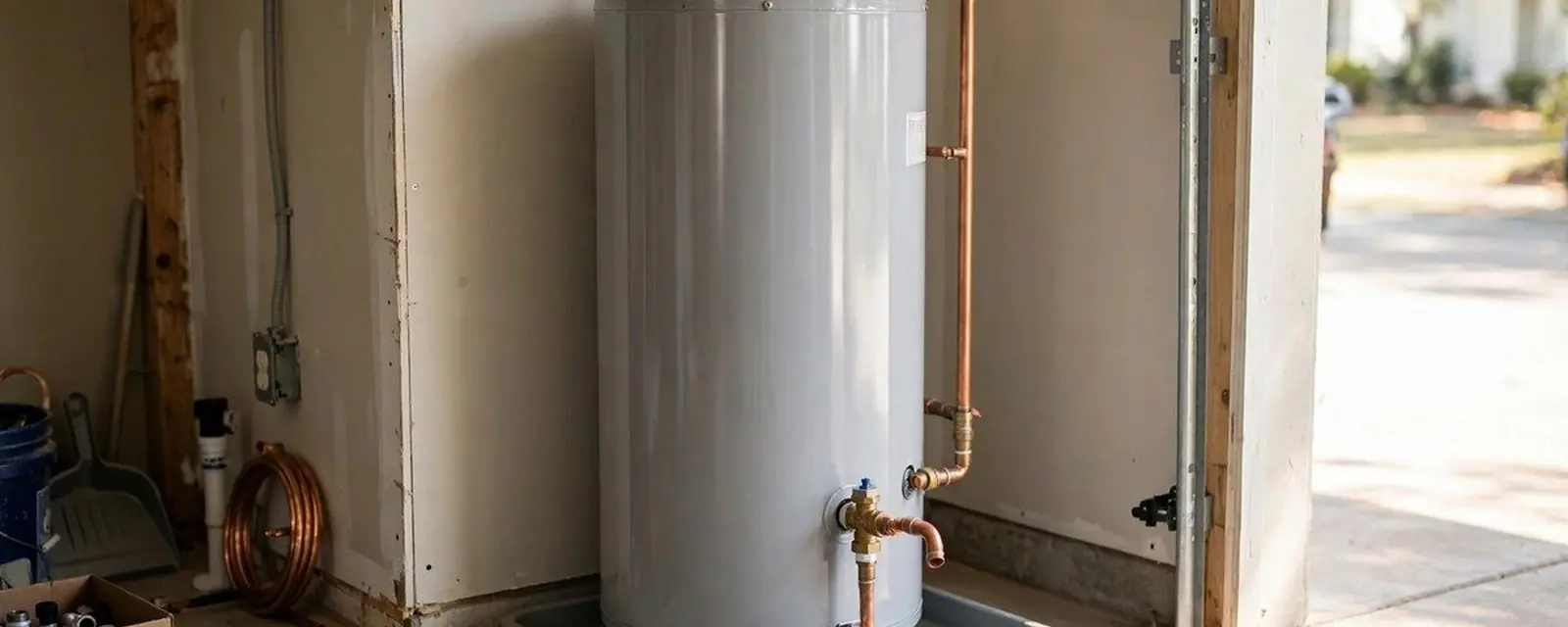
This page is for planned work. Think of a new heater in a remodel, a heater moved to a better spot, a fuel switch or an upgrade you have put off. If your tank is already leaking in Rosemount, start with our page on emergency water heater replacement.
A good installation is mostly about the details around the tank. Venting, a drain pan, a safe discharge line, an expansion tank where needed and proper support decide whether the heater runs well for the long haul.
Start with what you want to change
Every installation begins with one question: is this a like-for-like swap, or are you changing something? A like-for-like swap uses the existing gas line, circuit, vent and water connections. A change adds work that needs to be planned.
Moving the heater means new water lines, a new vent path or a new electrical run. Switching fuel means a new gas line or a new circuit. Adding an expansion tank or a drain pan is a smaller change, but it still needs space and fittings.
The best time to decide is before the old unit comes out. A short phone call about your house, your fuel and your plans lets us explain the scope and give a clear price before work starts.
Water heater installs are plumbing work under the Minnesota Plumbing Code in Minnesota Rules chapter 4714, with the relief valve discharge, expansion control and venting set by that code and the manufacturer. Ask the city Building Permits and Inspections office whether your swap needs a permit, since permit requirements are set locally.
Decisions to settle before install day
A few choices shape the whole job. Settle them early and the visit goes quickly.
- Fuel.Stay with the existing fuel unless you have a reason to switch. A fuel change adds gas piping or electrical work.
- Tank size.Match the tank to how many people use hot water at once. Recovery rate matters as much as capacity.
- Location.Check the space for the vent path, clearance around the tank, a drain pan and a safe place for the discharge line.
- Venting.A gas unit needs a vent that draws correctly. A power-vented or sealed-combustion model changes the route.
- Expansion control.If the water system is closed, an expansion tank absorbs pressure when the water heats. We check this on site.
- Water treatment.If you have or plan a softener, say so. The plumbing near the heater should leave room for it.
If you are considering a tankless model, read about tankless water heaters before you settle on a tank.
Permits: confirm with the city, not a web page
Permit rules for water heaters are set by the city, and they are not the same everywhere. In Rosemount, the Building Permits and Inspections office handles plumbing permits and inspections, and its number is 651-322-2024. The city page does not spell out a water heater rule, so call the office to confirm what applies to your job.
That call is worth making before the work, because it tells you whether an inspection is part of the project. The city says inspections require 24 hours' notice, so it helps to ask early rather than the day the new tank goes in.
We can explain what we do on site, such as the connections, the vent check and the testing. Whether a permit applies is a question for the city, and we will work with whatever they require.
Source: City of Rosemount Building Permits and Inspections page (office role, phone, inspection notice).
Planning a heater upgrade in Rosemount?
Call and describe what you want to change. We will explain the scope and give a clear price before work starts.
Venting, drain pan, discharge line and expansion tank
These are the parts people do not see once the heater is in, and they are the parts that matter most when something goes wrong.
Venting.
On a gas unit, the vent carries combustion gases outside. It must slope properly, stay tight and draw correctly. We check it as part of every gas install.
Drain pan.
A pan under the tank catches a slow leak and sends it to a safe place instead of the floor. It helps most when the heater sits above finished space.
Discharge line.
The relief valve needs a pipe that carries hot water or steam to a safe spot if it ever opens. This pipe must never be capped or blocked.
Expansion tank.
Heating water makes it expand. A tank on the supply absorbs that pressure so it does not strain the heater and the fixtures.
Support and clearance.
The tank sits level, with room for service and for airflow where the unit needs it. A stable, level base matters more than any accessory.
Code compliance in general terms means the install follows the Minnesota Plumbing Code and any local rules. Your city office confirms the local side.
Install day from dry fit to final test
A planned install follows a steady order, and most of the care goes into the final checks.
Walk the site.
The plumber confirms the location, the fuel connection, the vent path and the water lines, and agrees on the plan with you.
Remove the old unit.
Water is shut off, the tank is drained and disconnected, and the old unit is hauled away.
Set and connect the new heater.
The tank goes on a level base with a pan. New connectors, a relief valve, a discharge line and any expansion tank go in.
Vent, fill and start.
On gas, the vent is checked before the unit is lit. The tank is filled with air purged from the lines, then power or gas is restored.
Test and explain.
Every joint is checked for leaks, the temperature is set and verified at a tap, and the plumber shows you the shutoff valves and the controls.
Common planned projects and what each one adds
Different projects add different work. This table shows what changes so the scope is clear before anything starts.
| Project | What changes | Extra work to plan for |
|---|---|---|
| Like-for-like swap. | New tank in the same spot with the same fuel. | New connectors, a relief valve and a vent check. |
| Moving the heater. | New location in the house. | New water lines, vent path or electrical run, and a drain. |
| Gas to electric. | Remove gas and vent, add a circuit. | Electrical capacity, capping the gas line and a new circuit. |
| Electric to gas. | Add a gas line and vent. | Gas piping from the correct utility service, a vent path and combustion air. |
| Adding an expansion tank. | New tank on the cold supply. | Space, support and a pressure check. |
| Upgrading to a larger tank. | Bigger unit in the same place. | Clearance, connectors and sometimes a taller vent. |
Each project is scoped on site, and the price is given clearly before work starts.
Hire a licensed plumbing contractor in Minnesota
In Minnesota, a business that contracts plumbing work must hold a plumbing contractor license from the Department of Labor and Industry. The license requires a responsible master plumber, insurance and a bond. Rosemount Express Plumbing is licensed and insured.
You can check any contractor yourself. The Department of Labor and Industry has a license and registration lookup on its website, and you can search a name or a license type there. Ask any plumber you are considering to explain who will do the work and who is responsible for it.
State law also allows owners to do plumbing work in their own occupied home, unless a local ordinance forbids it. Gas, venting and hot water are areas where a mistake is costly, so many owners leave them to a licensed contractor.
If you are also planning other fixture or pipe changes, our page on plumbing installation covers that side.
What drives the price of an installation
We give you a clear price before work starts. These are the factors that set the number.
If the heater replacement follows water damage, keep the old tank's data plate details and photos of the damage in case your insurer asks.
Installation questions before you schedule
Permit rules are set by the city. Call the Rosemount Building Permits and Inspections office at 651-322-2024 to confirm what applies to your job.
In Minnesota, plumbing contractors must be licensed by the Department of Labor and Industry. You can check a license on the department's license and registration lookup. Rosemount Express Plumbing is licensed and insured.
Usually yes, if there is room for the vent path, clearance and drain. A move adds new water lines and sometimes a new vent or electrical run, and we scope that before the price is set.
Yes, but each switch adds work. Gas to electric needs a circuit and gas capping. Electric to gas needs a gas line and a vent. We explain the scope first.
It absorbs the extra pressure when water heats in a closed system. Whether you need one depends on your water system, and we check it on site.
A pan catches a slow leak and sends it to a safe place. It helps most where the heater sits above finished space.
We offer same-day appointments when available. Planned projects with a move or a fuel change usually take more preparation.
Residential Rosemount is served by Minnesota Energy Resources or Xcel Energy, depending on the address. Ask the utility that serves your home.