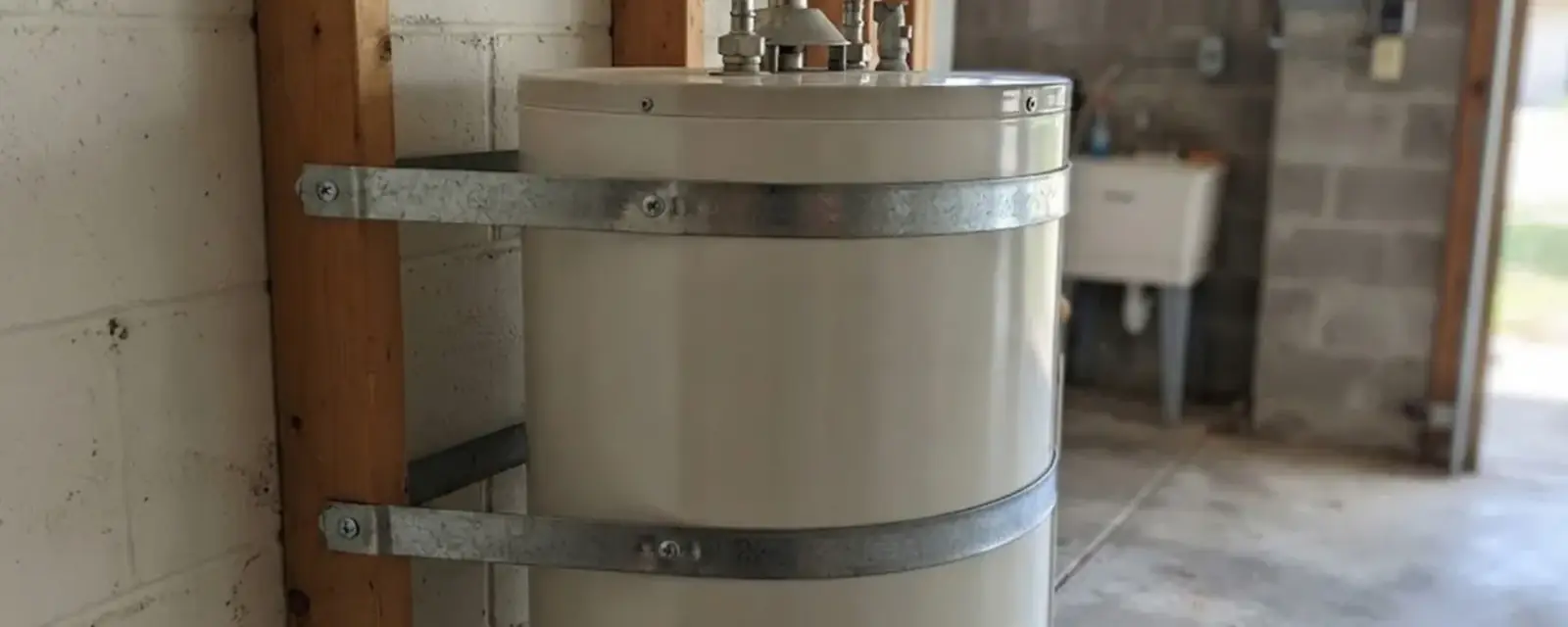
You can skip draining the whole tank, but you cannot skip draining altogether. The element screws into the tank wall and sits under water. Pull it with the tank full and the water comes out with it. Turn the power off at the breaker, confirm it is dead with a tester, then drain enough water to drop below the element you are changing.
That is the honest sequence, and it is a manageable job if you respect the electrical side. This guide covers the steps in order, how to test an element with a meter, how to tell when the thermostat or the breaker is the real problem, and when a failing tank means replacement is the smarter move in a Rosemount home.
Why this job is never drain-free
Most electric tanks have two elements, an upper one near the top and a lower one near the bottom. Each one is a heating coil that threads through the tank wall. The threaded end is the only thing holding the water back at that spot.
To reach the upper element you need to lower the water below it. To reach the lower element you need to drain the tank almost completely. Either way, a hose on the drain valve and a little patience are part of the job.
Replacing an element is electrical work on a plumbing appliance, so follow the manufacturer's instructions for your tank. Replacing the tank itself is plumbing work under the Minnesota Plumbing Code under Rules chapter 4714.
People ask about a no-drain method because draining feels like the messy, slow part. It is the part that keeps the job safe, and skipping it only moves the mess to your basement floor.
Confirm the element is the problem first
A new element costs little next to a wasted afternoon. Match what you see to the pattern before you buy anything.
- No hot water at all.The upper element, the upper thermostat or the breaker is the usual cause, because the upper element heats first in most tanks.
- Hot water that runs out fast.A failed lower element leaves you with only the top portion of the tank heated, so the supply drops quickly.
- Lukewarm water that never gets hot.Either one element is out or a thermostat is not calling for heat. Testing sorts it out.
- A breaker that trips again and again.A shorted element can leak current to the tank. Do not keep resetting the breaker. Test the element first.
- Popping or rumbling as the tank heats.That points to sediment and scale on and around the elements, which shortens their life.
If none of those fit, or the tank is leaking from the body, stop here. A leaking tank is a replacement question, not an element question.
The real sequence, start to finish
Follow these in order. Do not reorder them to save time, and never turn the power back on until the last step says so.
Turn off the breaker and prove it.
Switch off the water heater breaker, then remove the access panel and insulation. Check the terminals with a non-contact tester and then a meter. Tell anyone in the house not to touch the panel.
Shut the cold supply and open a hot tap.
Close the cold water valve on top of the tank. Open a hot faucet upstairs so air can enter the plumbing and the tank can drain.
Drain below the element.
Connect a hose to the drain valve and run it to a floor drain or outdoors. The water will be hot, so go slowly. Keep draining until the level is clearly below the element you are replacing.
Swap the element and gasket.
Disconnect the wires, unthread the old element with the right element wrench, and clean the seat. Fit the new element with a new gasket and match it to the rating on the tank's label.
Refill completely before any power.
Close the drain valve, reopen the cold supply and leave the hot tap running until water flows steady with no sputtering. Only then reconnect the wires, replace the panel and switch the breaker on.
Energizing an element that is not under water burns it out in seconds. That single mistake ruins more new elements than any other.
How to test an element with a meter
With the power off and proven dead, take one wire off each terminal of the element. Set your meter to measure resistance. Touch one probe to each terminal and read the display.
A reading that shows some resistance means the coil is intact. A reading of open line, often shown as OL, means the coil has burned through and the element is done.
- Terminal to terminal: some resistance means continuity. No reading means a burned-out coil.
- One probe on a terminal, the other on the metal mounting flange: any reading at all means the element is shorted to ground and must be replaced.
- Test both elements while the panel is open. One failed element often sits beside one that is on its way out.
Voltage checks with the power on are a different skill. If your test plan needs live power, that is the point to call a plumber or electrician.
Not sure it is the element?
Describe what the heater is doing and a plumber can help you decide whether to test, repair or replace. Same-day appointments when available.
When the thermostat or the breaker is the real culprit
Elements get blamed for problems that belong to other parts. This table shows the usual pattern.
| What you see | Likely culprit | What to check |
|---|---|---|
| No hot water, breaker is on | Tripped high-limit reset or bad upper thermostat | Look for the red reset button above the upper thermostat. Press it once with power off, then test again. |
| Breaker trips right away | Shorted element or damaged wiring | Do the terminal-to-flange test on both elements. Look for scorched wire ends. |
| Lukewarm only | Failed lower element or lower thermostat | Test the lower element with the meter before you buy a part. |
| Both elements test fine, still no heat | Thermostat, loose connection or supply problem | Check wire connections and have the thermostats tested by a plumber. |
| Hot water in bursts | Sediment covering the lower element | Flush the tank and test the element. A thick scale crust is a warning sign for the tank. |
Never bypass a thermostat or high-limit control to make the heater work. Those controls are the safety system.
What Rosemount water does to an element
The City of Rosemount lists its water hardness at 17 grains per gallon and calls it hard. Hard water drops minerals out as it heats, and that scale coats the element surface and settles at the bottom of the tank. A scaled element runs hotter than it should, so it burns out sooner than one in softer water.
The city's own water report lists preventing scale in hot water heaters as one advantage of home softening. It also lists real drawbacks, including added sodium, upkeep and the salt itself. Whether to soften is your call, but if you do not, a flush habit matters even more.
Draw a few gallons off the drain valve once or twice a year, with power off and the tank cooled a little. If the water runs cloudy or gritty, keep going until it clears. That small chore carries sediment out before it buries the lower element.
Source: City of Rosemount Water page and Public Works FAQ (hardness, 17 grains per gallon, undated city pages). Rosemount 2025 Drinking Water Report, section on the pros and cons of home water softening.
When a failing tank means replacement
An element swap fixes an element. It does not fix a tank that is wearing out. Here is how to tell which job you have.
An element or thermostat swap makes sense.
- The tank is dry on the outside and the fittings are clean.
- One element tests bad and the other tests fine.
- The tank drains clear with only a little sediment.
- The problem started suddenly, not after a slow decline.
Replace the tank instead.
- Water is pooling under the tank or dripping from the body.
- The elements are so scaled in place that they strip or snap during removal.
- The drain valve runs thick with rust or heavy grit, and it keeps coming back.
- Hot water has a rusty tint and the tank's label date is well behind you.
If your tank sits in the repair column, our water heater repair visit tests the elements, thermostats and wiring and tells you plainly what failed. If it sits in the replacement column, a water heater replacement is the better use of your money than a third repair.
Safety limits worth respecting
A water heater combines household current with a tank of very hot water. Treat both with care. If you are unsure about any step, stop and call.
Never work on the heater with the breaker on, never energize a dry element and never reuse an old gasket. If the unit is tripping the breaker and you cannot find the cause, leave the power off. We answer the line 24/7 for emergencies, and neighbors in Apple Valley and Hastings reach the same dispatch line as Rosemount callers.
Water heater element questions
No, not safely or realistically. The element sits under water, so the level has to drop below it first. You can drain only part of the tank for the upper element, but the lower element needs nearly the whole tank drained.
Yes, every time. Switch it off, then confirm there is no power at the terminals with a tester before you touch anything. Do not rely on the thermostat setting to keep the circuit dead.
Test each one with a meter set to resistance, with the power off and the wires disconnected. No reading across the terminals means a burned-out coil. Any reading from a terminal to the metal flange means the element is shorted. Both tests are quick.
Look at the high-limit reset button and the thermostats, then check the wiring connections for scorching. If everything looks right and the heater stays cold, have a plumber test the controls and the supply.
It can. The city lists hardness at 17 grains per gallon, and hard water leaves scale on elements and sediment in the tank. A regular flush and, if you choose, a softener both help. The city's report weighs the pros and cons of softening.
Often yes, if the tank is otherwise sound. The tank is already drained and open, and the second element has lived through the same water. If the tank itself is in poor shape, spend the money on a new tank instead.
Yes. The line is answered 24/7 for emergencies. Turn the breaker off if the heater is tripping it and leave it off until a plumber has looked at it.