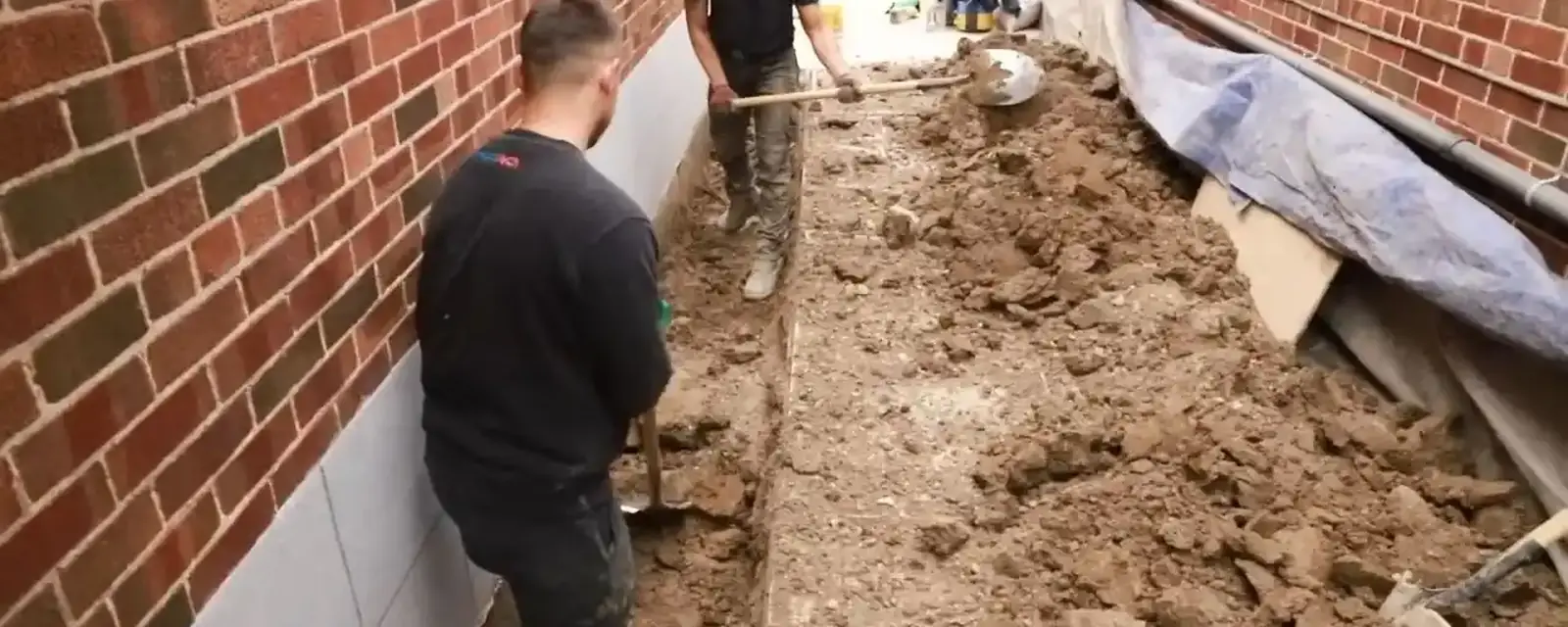
Here is the honest split. Exterior excavation, wall membrane and new drain tile outside the foundation is mostly foundation-contractor work, with an excavator and a crew. We are plumbers. We handle the plumbing side of a wet basement: the sump pit, the drain tile tie-in, the discharge line and the downspouts that dump roof water against your wall.
That split matters for cost, because the plumber-side fixes are often the cheaper first step. If water shows up at the floor edge after rain, look at roof water and the sump before you price a dig. This page explains what drives the cost of each path, so you can read quotes without anyone handing you a number first.
If water is on the floor right now, stay out of standing water near outlets and cords, lift belongings off the slab, and call us. A pump that has stopped or a frozen discharge line is a same-day job when available, and the line is answered 24/7. The excavation question can wait until the basement is dry.
Why the dig is the expensive part
The membrane and the drain tile are modest materials next to the labor and machine time needed to expose the wall. Every foot of foundation you uncover has to be dug, sloped or shored, protected from weather, and later backfilled and compacted. Decks, steps, patios and air conditioner pads either move or get worked around.
Interior systems skip nearly all of that. A crew opens the slab along the wall, sets drain tile in gravel and sends the water to a sump. That is why interior work is usually the lower-cost path, and why an exterior job should be a deliberate choice instead of a default.
Drain tile, sump basins and discharge lines are plumbing work under Minnesota's plumbing code in Rules chapter 4714, which draws on the Uniform Plumbing Code (UPC). The building rules for excavation and footings are separate, and your contractor should tell you which rules apply to which part of the job.
What moves the price of an exterior job
No honest article can give you a number for your house without seeing it. These are the factors that push an exterior quote up or down, roughly in order of weight.
For our part of the work, you get a clear price before work starts. We say what is included, what is not, and what could change the scope once we see the pit or the pipe. Ask any foundation contractor for the same in writing, with restoration spelled out line by line.
Interior drainage versus exterior excavation
Both approaches try to keep water from building pressure against the wall and slab. They get there by different routes, and the cost profile is different too.
Interior drain tile and sump.
- Works from inside, so the yard stays intact.
- Takes water at the floor and wall joint and moves it to a pit.
- Depends on a working pump, a check valve and power.
- Does not coat the outside of the wall.
- Fits plumber-side work, including the discharge line.
Exterior excavation and membrane.
- Exposes the full wall to the footing.
- Lets a contractor repair and coat the outside face.
- Can stop seepage through the wall itself.
- Disturbs the yard, plantings and anything on top.
- Is mostly foundation-contractor work, not plumbing work.
Our basement waterproofing page covers the interior and plumbing-side options in more detail. If your water is coming through the wall itself and not along the floor edge, that is where exterior work earns its cost.
Wet basement and not sure where to start?
Call and we will talk through what the water is doing before anyone recommends a dig. For any plumbing-side fix you get a clear price before work starts.
What Rosemount's frost rule means for the dig
Minnesota Rule 1303.1600 sets the minimum footing depth for freezing at five feet in Zone I and three and a half feet in Zone II. Dakota County is in Zone II. So the footing under a Rosemount house sits at least 3.5 feet down, and exposing the wall to the footing means digging at least that deep.
Plan for a trench that deep, wide enough to work in and sloped for safety. That is the main reason the dig drives the price. It is a footing rule, not a water line rule, so do not use it to guess where a service line runs. Call 811 first.
The city's 2040 plan describes older, pre-1940s neighborhoods on a rigid grid west of South Robert Trail, north and south of 145th Street West. Foundations in an area like that are more likely to be old, so the condition of the wall matters more when you compare options. Most of the city is far newer, since the same plan says a little less than 20 percent of homes are over 35 years old.
Source: Minnesota Rules 1303.1600 (Revisor of Statutes), Rosemount 2040 Plan Chapter 4 Housing (rosemountmn.gov), Gopher State One Call and Minnesota Department of Public Safety.
Cheaper fixes to try before anyone digs
Most wet basements we see have a roof water or sump problem before they have a wall problem. Work through these in order and watch the result.
Move roof water away.
Extend downspouts so they empty well away from the wall onto ground that slopes away. Clear gutters so they do not spill at the foundation.
Check the grade.
Soil that settled against the wall points water at it. Add fill so the ground falls away from the house.
Test the sump.
Pour a bucket of water into the pit. The pump should start, empty it and shut off. A stuck float or a failed check valve floods a basement that was otherwise fine.
Add or tie in drain tile.
If water enters at the floor edge, interior drain tile feeding a sump can intercept it with far less digging than an exterior job.
Watch a full wet season.
Mark the damp spots and note whether they follow rain or snowmelt. Decide on a dig only after the cheaper fixes have had a fair test.
Our sump pump installation and repair service covers the pit, the pump, the check valve and the discharge line. Fixing those is plumbing work, and it is often the cheapest first step.
Match the symptom to the likely fix
Use this as a starting point, not a diagnosis. A visit lets someone look at the actual wall and pit.
| What you see | Likely cause | First step | Who usually handles it |
|---|---|---|---|
| Water at the floor and wall joint after rain. | Roof water or a high water table. | Fix downspouts, test the sump. | Plumber or homeowner. |
| Damp patch mid-wall, dry floor. | Crack or porous wall. | Monitor, then consider exterior repair. | Foundation contractor. |
| Pump runs all the time. | Undersized pump or heavy groundwater. | Check pump, check valve and discharge. | Plumber. |
| Water in the pit and a silent pump. | Dead pump, stuck float or no power. | Check the outlet, then replace the pump. | Plumber. |
| Bowed wall or stair-step crack. | Structural movement. | Stop and get structural advice. | Foundation contractor or engineer. |
A bowed wall is not a plumbing problem. Do not wait on a pump repair if you see one.
Questions to put to every contractor
Homeowners across Rosemount, Apple Valley and Inver Grove Heights face the same choice, and the questions are the same. Ask each contractor what the scope is, what is left to you and how the yard will look afterward.
Ask where the new drain tile sends its water. Inver Grove Heights tells residents that sump pumps may not discharge into the sanitary sewer and that hoses must drain outside the home. Rosemount's own rule is something to confirm with the city, so ask any contractor how the discharge will be routed and who checks that it is allowed.
In Apple Valley the city plan says over half of housing units are more than 30 years old. Older houses are where we see failed pumps, tired check valves and downspouts that were never extended. Those are the cheap fixes to rule out before a dig.
- What exactly is included, and what is excluded.
- Who calls 811 and who handles permits.
- How the discharge is routed and who confirms it is allowed.
- What restoration is included, line by line.
- What warranty applies, and to whom, in writing.
Exterior waterproofing questions
It is worth it when water comes through the wall itself, or when the outside face of the foundation is damaged. When water enters at the floor edge after rain, roof water and the sump are the first things to fix, and they cost less.
Usually yes. The extra cost is in digging, shoring, backfilling and restoring the yard, not in the membrane. Interior systems avoid most of that work.
At least 3.5 feet. Minnesota Rule 1303.1600 sets the minimum footing depth for freezing at 3.5 feet in Zone II, and Dakota County is in Zone II. To reach the bottom of the wall, a crew has to dig at least that deep, and your 811 locate comes first.
No. That is mostly foundation-contractor work. We handle the plumbing side: the sump pit and pump, drain tile tie-ins, the discharge line and downspout problems.
Not always. A sump removes water that reaches the drain tile. It does not seal a cracked wall, so seepage through the wall can continue even with a healthy pump.
Stay out of standing water near outlets and cords, lift belongings off the floor, and call. The line is answered 24/7, and a dead pump or frozen discharge line is a same-day job when available.