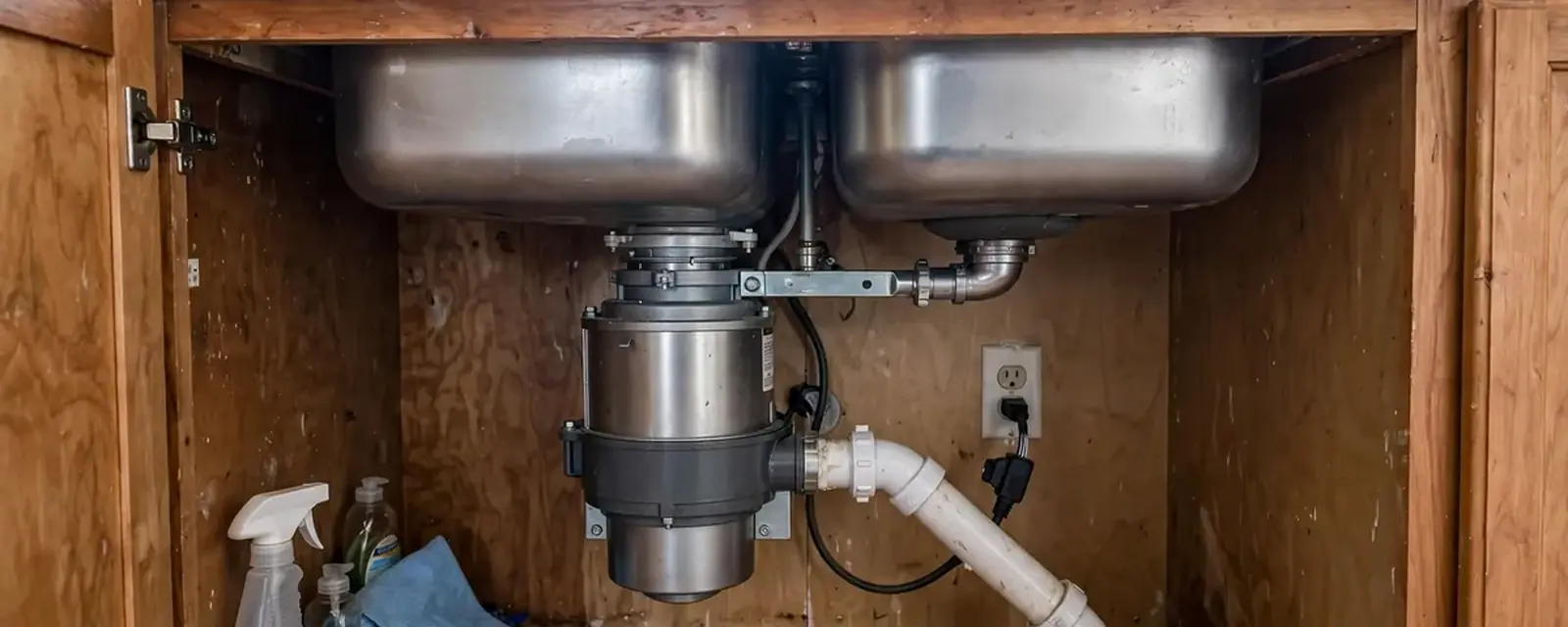
If your disposal is jammed, leaking or smells of burning, switch it off and turn off its power at the breaker panel. Do that first, because a wall switch alone does not isolate the unit. Never put a hand into the disposal, even when it is off. Our line is answered 24/7 if you need help deciding what to do next.
Most disposal calls turn out to be a jam, a tripped reset or a leak at one of three joints. Some are really clogs in the sink drain beyond the disposal. Rosemount Express Plumbing repairs and installs disposals in Rosemount and nearby towns, with a clear price before work starts.
This page explains what the hum, the silence and the drip each mean, what is safe to try and what is not, and when replacement is the better choice. It also covers the dishwasher connection and the items that wreck a disposal.
Disposal jammed or leaking: switch off the power first
These steps protect you first and the unit second. Follow them in order.
- Turn off the power at the panel.Flip the breaker that feeds the disposal. If you are not sure which one it is, switch off the kitchen circuits and keep the lights on elsewhere.
- Keep your hands out.Never reach into the disposal, even with the power off. The blades and flywheel can move, and a hand in the opening is how people get hurt.
- Close the sink drain and stop using the water.Do not run the tap or the dishwasher while the unit is leaking or clogged. Water will only spread.
- Catch the leak.Set a bucket under the unit and empty the cabinet. Note where the water is coming from: the top flange, the side housing or a pipe joint.
- Call the 24/7 line.Tell us what you see and whether the power is off. We will say whether it can wait for a same-day appointment when available.
Burning smells or smoke mean the motor is failing and the power must stay off. A unit that runs without turning should be left alone until someone has looked at it.
Humming, silent, slow or noisy: what each sound means
The sound a disposal makes tells us a lot before anyone opens the cabinet. Here is how to read it.
Hum but no spin.
Something is jammed against the flywheel. With the power off at the panel, many units have a hex socket on the bottom that turns the flywheel by hand and clears the jam.
Silent, no hum.
The unit has tripped its overload or lost power. Look for a small red reset button on the bottom, press it after the power is back on, and check the breaker.
Slow drain, no jam.
The disposal is running, but the sink drain past it is restricted. Grinding more food will not fix a clog in the pipe.
Grinding or rattling.
A spoon, bottle cap or bone fragment is loose inside, or the grinding parts are worn. Persistent noise after the debris is removed points to wear.
The red reset button and the hex socket are the only safe first checks. If the unit still will not run after both, the motor or the jam needs a plumber.
Where a disposal leak comes from
A disposal can leak at several places, and each one has a different cause and fix. Finding the source comes first.
| Leak location | Common cause | Usual outcome |
|---|---|---|
| Top, at the sink flange | Failed putty or loose mounting ring | Reseal the flange and tighten the mount. |
| Side of the housing | Cracked casing or a failed internal seal | Replace the unit. |
| Drain pipe joint or dishwasher hose | Loose clamp or worn gasket | Tighten or replace the connection. |
| Bottom of the unit | Corroded casing or worn seals | Replace the unit. |
A leak from the housing or the bottom is rarely repairable. Water under the unit usually means replacement.
The do-not-flush list also protects your disposal line
The City of Rosemount lists items that must never be flushed: diapers, wipes of any kind including flushable ones, facial tissue, cotton balls, swabs and pads, paper towels, cloth, kitty litter, dental floss and hair. Many of those items jam or wrap around disposal parts, and they also lodge in the kitchen drain beyond it. Keep them out of the sink as well as the toilet.
The same city page points out that the pipe from the house to the street sewer main is private. That line belongs to the homeowner, so a clog caused by what went down the drain is a cost you carry. Our advice on grease is plain: let it cool and put it in the trash, not the sink.
Disposal drains connect to the kitchen waste line, and how that connection is vented and trapped follows the Uniform Plumbing Code (UPC) as adopted in Minnesota Rules chapter 4714. A repeat clog after a new disposal is often a trap or slope problem, not the unit itself.
Source: City of Rosemount, Sanitary Sewer page.
Disposal jammed, smoking or leaking?
Power off at the panel, keep your hands out, then call. The 24/7 line is answered.
What never goes down a disposal
A disposal grinds soft food scraps. It does not handle everything that fits through the opening.
- Fibrous or stringy food.Celery, corn husks and artichoke leaves wrap around the blades. Bones and fruit pits can jam the flywheel.
- Grease and cooking oil.It cools and coats the pipe walls, and the clog forms downstream where you cannot see it.
- Coffee grounds and eggshells in quantity.Grounds pack into a sludge, and shell fragments settle in the trap.
- Starchy and expanding foods.Rice, pasta and potato peels swell with water and gum up the drain.
- Non-food items.Wipes, paper, cloth, floss, hair and cat litter are on the city's do-not-flush list and also wreck a disposal line.
Repair or replace the disposal
A disposal is not worth saving every time. We tell you which side your unit is on before work starts.
Repair usually wins when.
- The unit is jammed but the motor is sound.
- The leak is at the flange, a hose or a drain joint.
- The reset button restores power.
- The unit is fairly new and quiet.
Replacement usually wins when.
- The housing leaks or the casing is corroded.
- The motor hums and the flywheel will not free.
- The unit trips often or runs rough.
- Repair parts cost close to a new disposal.
A clogged kitchen sink can look like a disposal fault. Our drain cleaning service clears the line past the unit. If the sink faucet drips as well, see faucet and sink repair.
Installing a replacement disposal and the dishwasher connection
A new disposal sounds like a swap, but the details decide whether it leaks. This is how a typical installation goes.
Power off and remove the old unit.
Switch off the breaker, disconnect the drain and dishwasher hose, and release the mounting ring. Lift the old unit away.
Reseal the sink flange.
Clean the flange area and set it with fresh putty or the seal the new unit calls for, then fasten the mounting assembly.
Connect the dishwasher inlet.
If a dishwasher drains into the disposal, its hose attaches to a port on the unit. Knock out the plug in that port first, or the dishwasher will not drain.
Hang the unit and connect the drain.
Lock the disposal onto the mount, align the discharge and tighten the drain joint.
Wire, restore power and test.
A plug-in or hardwired connection is made safe and checked. Run water, check every joint and run the dishwasher to look for leaks.
A disposal that is added where none existed needs new wiring and drain work. For that scale of job, our plumbing installation page explains what we do.
What drives the price of disposal repair and installation
We do not publish numbers because the unit under your sink decides the work. These factors set the price.
You get a clear price before work starts, with the unit and labor explained. If a repair would not last, we tell you that and show the replacement option.
Garbage disposal repair and installation questions
Yes. The line is answered 24/7. Turn off the disposal's power at the breaker panel first, keep your hands out of the unit, then call.
No. Never put a hand into the disposal, even with the switch off. Turn off the power at the panel and use the hex socket on the bottom of the unit if it has one.
It resets the overload protection after the motor overheats or jams. Press it once the jam is cleared and the power is back on.
The casing or an internal seal has failed. A unit that leaks from the bottom or housing is usually replaced rather than repaired.
The clog is probably in the pipe past the disposal. Grinding does not clear it, and the line needs cleaning.
No. Let grease cool and put it in the trash. It builds up in the pipe beyond the disposal where you cannot reach it.
Yes. We connect the dishwasher hose to the disposal inlet and check that the dishwasher drains and nothing leaks.