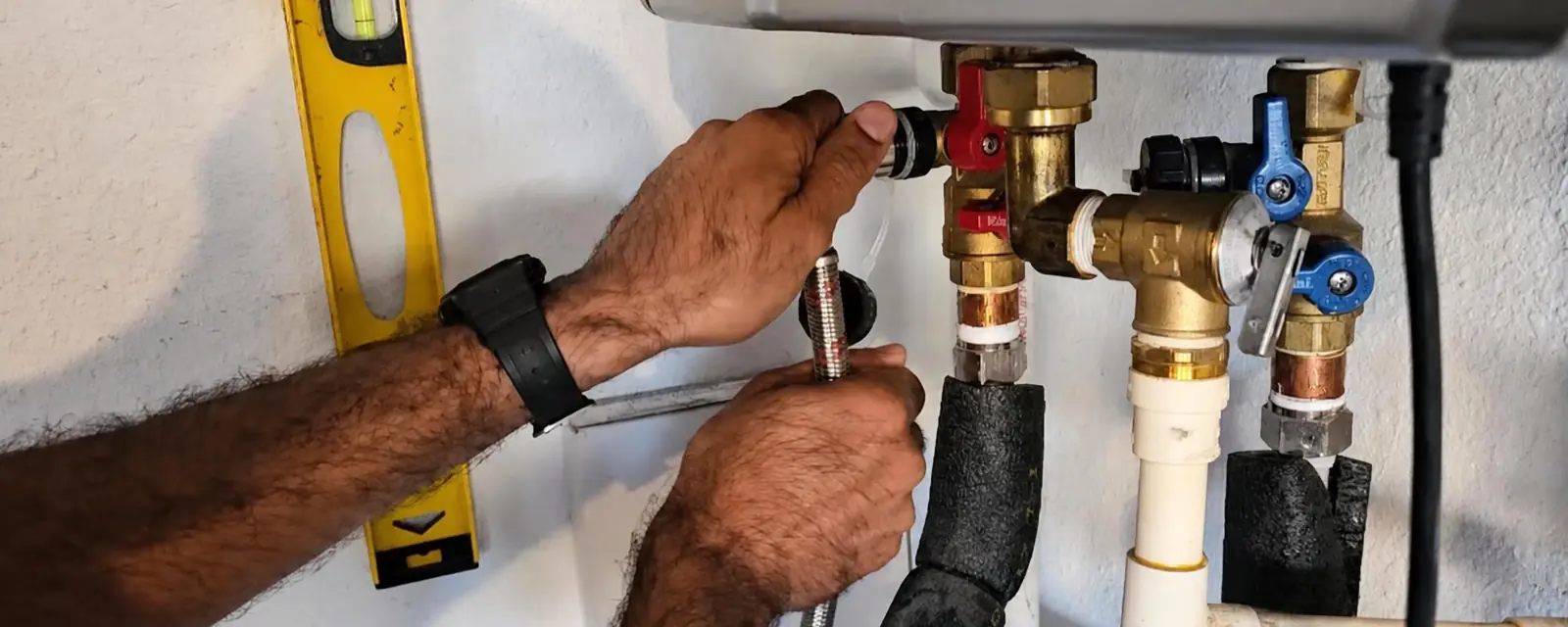
Three concerns pull the setting in different directions. A lower setting reduces the chance of a burn, a higher setting gives you more hot water at the tap, and sanitation worries push some people higher. We will not hand you a number to treat as a rule, because the manual for your unit and the people in your house decide it.
This guide explains each trade-off, how a Minnesota winter changes what the heater has to do, and how kitchen, shower and dishwasher needs differ. It also covers how to change the setting safely and when the answer is to call a plumber instead of turning a dial.
Three things the setting has to balance
Each one is real. None of them wins every time.
Scald risk.
Hot water can burn quickly, and children, older adults and anyone with reduced feeling in their skin are at higher risk. A lower setting gives more margin.
Comfort.
A shower that runs lukewarm is a real annoyance. Setting too low can leave you mixing in less cold water than you would like, or running out of comfortable heat.
Sanitation.
Some households want hotter water for washing dishes or laundry. This is a legitimate concern, but we do not give a figure. Ask your plumber and read the manual.
Equipment limits.
Every unit has an allowed range and a default. Settings outside the range can cause errors, scale or safety problems.
Notice that none of those four is about saving a few cents. Treat the setting as a safety decision first.
Scald risk is the one you cannot undo
Water that is hot enough to be useful for cleaning is also hot enough to burn. The danger is greatest for young children and older adults. A burn happens faster than most people expect, and you cannot reverse it.
A tankless heater does not store hot water, so it can deliver a steady supply at whatever the dial says. That is good for comfort and demands care with the setting. If anyone in your home is at higher risk, ask a plumber about options such as mixing valves or anti-scald fixtures.
Follow the manufacturer's guidelines for the setpoint and for any scald protection your unit offers. Installation and venting of the unit fall under the state's UPC-based plumbing code, chapter 4714 of Minnesota Rules and the manual.
Do not rely on guesswork or a number from a forum. Check the manual, test the water at the tap with a thermometer and adjust from there.
What a Minnesota January does to the setting
The Minnesota DNR lists Twin Cities January average lows of about 9 to 11 degrees Fahrenheit, measured at the airport station. Rosemount's own numbers are not published there, but the pattern holds across the metro: winter is the coldest time of the year, and the water coming into your home is at its coldest too.
Colder incoming water means the heater has to add more heat to reach the same setting. That is why a unit can seem to struggle in January when it ran fine in summer. At a high flow rate, it may not be able to reach the set temperature at all, and the output water can come out cooler than you chose.
In practice, do not raise the dial in winter just to chase comfort. Lower the flow at the tap, use fewer fixtures at once and check the manual's performance notes for how the unit handles cold inlet water. If it still cannot keep up, that is a sizing question for a plumber.
Source: Minnesota DNR Twin Cities Climate Calendar, January 1991 to 2020 normals, average minimum temperature (airport station, not Rosemount).
Kitchen, shower and dishwasher needs
Different fixtures want different things. Here is how to think about each one.
| Fixture | What matters | What to check |
|---|---|---|
| Shower. | Comfort and scald safety. | Test the temperature at the showerhead and think about who uses it. |
| Kitchen sink. | Quick hot water for dishes and cleaning. | Notice how long it takes for hot water to arrive and whether it is too hot for hand washing. |
| Dishwasher. | Whether it heats its own water. | Read the dishwasher manual for its water temperature guidance. |
| Washing machine. | Cycle needs and fabric care. | Follow the care labels. Most cycles mix their own temperature. |
| Bathroom sink. | Safety for kids and guests. | Test at the tap before you assume it is safe. |
Check each appliance's own manual. Some heat their own water and do not need a higher setting from the heater.
Hot water not matching the setting?
Call and describe what the water is doing. Same-day appointments are available when the schedule allows.
A lower setting versus a higher one
Neither is right for every home. This is how the trade looks in practice.
Leaning lower.
- More margin against scalds, especially with children or older adults in the house.
- Less strain on the unit and less scale in the heat exchanger over time.
- Water may feel less hot in winter, so you may mix in less cold.
- Dishwasher guidance still needs to be checked.
Leaning higher.
- More hot water at the tap before it needs to be mixed.
- Higher burn risk, which grows with the setting.
- More wear on the unit and more scale over time.
- Only makes sense if the manual allows it and your household is not at higher risk.
If sanitation is the reason for going higher, bring that question to a plumber instead of choosing a number alone.
How to adjust the setting safely
Most units have a control panel or a remote controller. The manual shows the exact method.
Read the manual's range and default.
Find the allowed range and the factory default. Do not exceed the range.
Note the current setting.
Write down the setting before you change it so you can return to it.
Change it in small steps.
Make one small change at a time. Let the system settle before you judge the result.
Test at the tap.
Use a thermometer at the fixture, and keep your hand out of the stream until you know the water temperature.
Tell the household.
Make sure everyone knows the change, especially anyone who showers or bathes children.
If the water does not match the setting, suspect scale, a blocked inlet screen or flow that is too high for the unit.
The manual governs, and a plumber can confirm
Plumbing codes and manufacturer rules vary and change. We will not state a code number as though it applies to your house. The manual for your unit and your local authority govern, and a plumber can help you apply them.
If the unit will not hold temperature, swings between hot and cold or shows temperature-related error codes, our water heater repair visit can find out whether it is scale, a sensor or a flow issue. If you are thinking about a new unit, our tankless water heater work covers sizing for your household's real demand.
When the problem is not the setting
Water that never gets hot enough, or that fluctuates, is often blamed on the dial. The real cause is frequently a scaled heat exchanger, a clogged inlet screen or a unit that is undersized for the number of fixtures running at once. Turning the dial up just hides the problem.
We serve Rosemount and nearby towns, including Apple Valley and Farmington. A plumber can test the output, look at the unit's history and give you a clear price before work starts.
Tankless temperature questions
Use the lowest setting that meets your household's needs and stay inside the range in the manufacturer's manual. We do not give a single number because homes differ. Ask a plumber if anyone in your house is at higher risk of burns.
It is a fair question, and we do not state a threshold. Follow the manual, consider your household's needs and ask a plumber. Do not raise the dial without weighing the scald risk.
Check the dishwasher's own manual. Some models heat their own water and do not need a higher setting from the water heater.
Incoming water is coldest in winter, so the heater has to add more heat to reach the same setting. At high flow it may fall short. Reduce how many fixtures run at once and check the manual's performance notes.
The Minnesota DNR lists average January lows of about 9 to 11 degrees Fahrenheit at the Twin Cities airport station. That is not a Rosemount measurement, but it shows how cold incoming water can be, which affects flow and temperature rise.
It can add a safety margin in homes with young children or older adults. A plumber can explain the options and whether they fit your setup.
Yes. The line is answered 24/7 for emergencies. Describe what the unit displays and a plumber can tell you what to check.